Industrial Robotics Integration & Engineering Services | Ludvika, Dalarna
For facilities in Ludvika, Dalarna looking to optimize material handling, LVH Systems provides turnkey Industrial Robotics Integration solutions focused on palletizing and high-speed sortation. Our engineering group in Sweden architects robotic systems that utilize decentralized I/O and EtherCAT motion backbones to coordinate hundreds of signals per second. We specialize in the integration of vision-guided robots for randomized pick-and-place, utilizing advanced algorithms for collision avoidance and path optimization. Our deployments in Dalarna prioritize operational uptime through redundant control architectures and predictive maintenance telemetry, ensuring that robotic cells function as high-performance nodes within the facility’s broader automation framework.
Vision-guided robotics (VGR) integration in Ludvika, Dalarna provides the technical flexibility required for randomized part handling and automated quality inspection. LVH Systems delivers specialized VGR solutions across Sweden, focusing on the marriage of high-speed industrial cameras with robotic kinematic control. The integration challenge lies in the calibration of the 'Camera-to-Robot' coordinate space, ensuring that the visual data is accurately translated into motion commands. Our engineering group in Dalarna utilizes advanced 2D and 3D vision algorithms to identify part orientation, scale, and surface defects, allowing the robot to adjust its approach path dynamically. We implement low-latency communication between the vision processor and the robot controller via Gigabit Ethernet or specialized industrial protocols. For facilities in Ludvika, we prioritize 'Visual Intel,' where the vision system not only guides the robot but also feeds data back to a centralized SCADA system for production analytics and traceability. We ensure that lighting environments are engineered for stability and that the vision logic accounts for variations in part color or ambient light. LVH Systems provides the technical clarity needed to deploy vision systems that reduce manual sorting and increase the intelligence of the robotic footprint.
Providing technical integration services to industrial facilities within the Ludvika metropolitan area and throughout Dalarna.
Technical content for Industrial Robotics Integration in Ludvika, Dalarna last validated on April 5, 2026.
Services
Collaborative Safety Assessment
We conduct rigorous risk assessments for collaborative robot (cobot) workstations in Ludvika. LVH Systems defines safe speed and force limits according to ISO/TS 15066, ensuring that collaborative Industrial Robotics Integration applications in Dalarna prioritize human safety while delivering the intended productivity gains for Sweden operators.
Safety PLC Logic Development
Our technical group develops safety-rated logic for robotic cells in Dalarna, managing emergency stops, door interlocks, and safe-speed zones. For facilities in Ludvika, we provide documented verification of safety performance levels (PLd/PLe), ensuring that the control system remains fundamentally deterministic and fault-tolerant.
Safe-Move & Speed Monitoring
We configure safety-rated software modules, such as FANUC Dual Check Safety (DCS) or KUKA SafeOperation, for systems in Ludvika. This ensures that robot motion in Dalarna is restricted to validated Cartesian zones and speeds, reducing the footprint of safety guarding while protecting equipment and personnel.
Redundant Safety Networking
LVH Systems implements safety-over-bus protocols like CIP Safety and Fail Safe over EtherCAT (FSoE) for robotic lines in Dalarna. This architecture ensures that safety-critical signals in Ludvika are transmitted with high integrity, allowing for centralized safety management across multi-robot Sweden installations.
Safety Validation Reporting
We provide comprehensive functional safety validation reports for every robotic integration in Ludvika. Our engineers document every safety test and calculation in Dalarna, providing facility owners in Sweden with the auditable proof of compliance required for regulatory and insurance standards.
Operator Safety Training
Technical training for Ludvika personnel focuses on the safe operation and recovery of robotic cells. We educate your Dalarna team on safety-rated bypasses, recovery procedures, and regular proof-testing requirements, ensuring that Industrial Robotics Integration maintenance in Sweden is performed according to strict safety protocols.
Our Process
ISO Risk Assessment
Identification of hazardous zones and interaction points within the Ludvika cell defines the required Performance Levels for all safety-related parts of the Industrial Robotics Integration control system in Dalarna.
Safety Logic Architecture
Development of dual-channel safety-rated logic within a dedicated safety PLC ensures that every emergency stop and gate switch is managed deterministically for your Sweden facility.
Safety Network Configuration
Configuring CIP Safety or FSoE protocols for the robotic cell in Ludvika provides high-integrity communication between the robot controller and safety I/O modules throughout the Dalarna facility.
Forced Fault Testing
Simulating internal and external hardware failures at the lab validates that the safety logic responds correctly, preventing dangerous states in Industrial Robotics Integration systems before they reach Ludvika.
Field Safety Validation
On-site testing of light curtains, area scanners, and safety-rated monitored stops in Dalarna confirms that the integrated safety system provides the required protection for personnel in Ludvika.
Validation Documentation
Preparation of the final validation report and SISTEMA calculations provides your Sweden facility with auditable proof that the robotic cell meets all international safety compliance standards.
Use Cases
High-volume case packing of flexible pouches requires robots to handle unstable product shapes at high speeds. We deploy delta robots using high-flow vacuum grippers and integrated pouch-settling logic. The orchestration strategy uses a master encoder to sync robot motion with a dual-lane conveyor, allowing for continuous product loading without stopping the line. The objective is to achieve a throughput of 180 pouches per minute while ensuring correct pouch orientation for the subsequent case-sealing process.
Automated munitions handling in secure defense facilities requires robotic systems built for absolute logic integrity and auditability. We implement a hardened 6-axis robot cell with a dedicated safety PLC and air-gapped network architecture. The control logic manages the precision movement of high-explosive components, utilizing dual-channel safety-rated position feedback. This strategy ensures that every robotic move is verified against a validated safety-state map, mitigating the risk of mechanical anomalies in a high-consequence operational environment.
High-speed stacking of lithium-ion battery electrodes requires micron-level alignment and rapid cycle rates. We integrate high-performance linear robots with high-speed vision feedback and vacuum grippers. The control logic performs real-time offset corrections for every layer, maintaining a stacking tolerance of +/- 20 microns. This high-fidelity orchestration is critical for achieving the high energy density and safety required for modern EV battery cells, maximizing production throughput in a high-volume manufacturing environment.
Technical Capabilities
- Safety-instrumented functions (SIF) must be proof-tested regularly to verify they still meet the required safety integrity level defined during design.
- The kinematic singularity at the robot's wrist, often called the 'overhead singularity,' occurs when joints 4 and 6 become co-axial.
- IO-Link communication for robot end-effectors allows for the transmission of diagnostic data and parameter settings to sensors via a standard cable.
- Functional safety validation for robotics includes measuring the stopping distance of the robot under maximum load and speed conditions.
- High-speed delta robots utilize carbon-fiber arms to reduce inertia and achieve accelerations exceeding 10G in packaging applications.
- Absolute encoders utilize multi-turn tracking to maintain position data through battery-backed memory or non-volatile electronic registers.
- Robot master logic in a PLC should be architected using state-machine principles to ensure predictable transitions between operational modes.
- Managed industrial switches with port-mirroring allow for the forensic analysis of network protocol errors in robotic communication links.
- Functional safety calculation tools like SISTEMA combine MTTFd and diagnostic coverage to determine the achieved Performance Level of a cell.
- Tool-flange coordinate systems serve as the reference point for mounting all end-of-arm tooling and defining the tool-center-point.
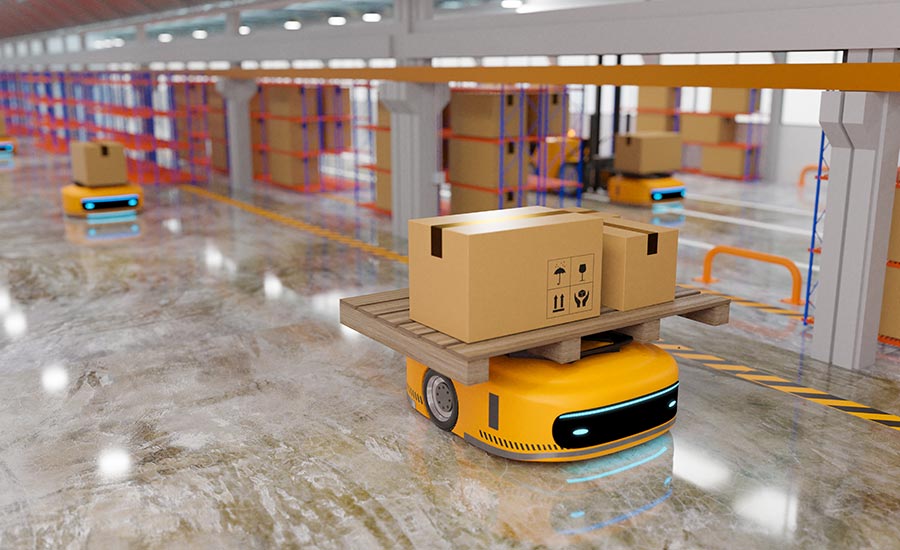
Scalable multi-robot orchestration for Industrial Robotics Integration production.
A panoramic view of a modern manufacturing facility showing a series of integrated robotic cells. Each cell functions as an intelligent node within a facility-wide deterministic network, synchronized for high-volume automated production.
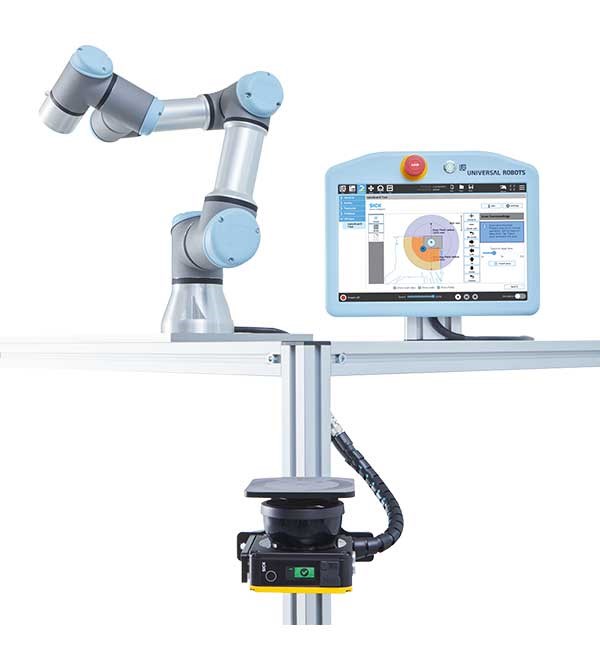
Safe collaborative integration for Industrial Robotics Integration applications.
A collaborative robotic workstation showing a cobot performing precision assembly alongside a human operator. The integration emphasizes power and force limiting (PFL) sensors and safe-limited speed zones, adhering to ISO/TS 15066 specifications.
Frequently Asked Questions
What is the typical ROI period for an industrial robot integration in Ludvika?
ROI usually ranges from 12 to 24 months, driven by increased throughput, reduced scrap, and lower labor volatility. We perform a technical audit in Dalarna to quantify current manual cycle costs and contrast them with predicted robotic efficiency gains for your Sweden facility.
Which industrial robot brands does LVH Systems support in Dalarna?
Our group provides specialized integration for Tier-1 brands including FANUC, ABB, KUKA, and Yaskawa. We focus on multi-platform logic development, ensuring that robotic assets in Ludvika are perfectly synchronized with your site's existing PLC standards, whether Rockwell, Siemens, or Beckhoff.
How does multi-robot orchestration impact the integration cost?
Coordinating multiple robots in a shared workspace in Ludvika requires advanced collision-avoidance logic and deterministic networking. The cost reflects the additional engineering hours for multi-axis synchronization and simulation, ensuring that high-density Industrial Robotics Integration cells in Dalarna operate without unplanned mechanical interference.
Does LVH Systems provide 2D or 3D vision guidance for robotics in Ludvika?
Yes, we integrate high-speed vision systems for randomized pick-and-place and automated inspection. Our engineers in Dalarna configure the camera-to-robot coordinate mapping, allowing for high-fidelity part identification and dynamic kinematic adjustment for sophisticated Sweden manufacturing processes.
Can we reuse existing mechanical safety fencing for a new robotic cell?
Reusability depends on the current fence's compliance with ISO 10218 standards. During our Ludvika technical audit, we evaluate physical heights and reach-over risks in Dalarna. We often augment existing fencing with modern safety PLCs and light curtains to achieve the required Performance Level.
What level of documentation is provided with a robotic project in Sweden?
We deliver a comprehensive technical package including uncompiled robot source code, electrical schematics, and redline reach studies. This ensures that your facility in Ludvika has the internal resources needed for long-term ownership and diagnostic self-sufficiency without vendor lock-in.
Do you offer simulation-only services before hardware purchase?
Yes, we perform reach and cycle-time studies to validate a robot's suitability for a specific task in Dalarna. This technical verification in Ludvika prevents expensive hardware mismatches, ensuring the selected Industrial Robotics Integration platform can physically achieve the required kinematic moves and production targets.
How is end-of-arm tooling (EOAT) specified for Industrial Robotics Integration projects?
EOAT is custom-engineered based on your product weight, surface material, and cycle-time needs. For projects in Ludvika, we utilize 3D simulation to verify that the gripper mass does not exceed the robot's payload inertia limits, ensuring stable and reliable handling in Dalarna.
Related Resources
Navigation
Technical Foundations
Quantify Your Robotic Scope in Ludvika
Generic automation quotes lead to underscoped integration risks. Utilize our technical diagnostic to define your I/O magnitude, kinematic requirements, and safety performance levels before vendor introduction.
Begin Robotic Scope Diagnostic