Technical Industrial Robotics Integration Hub: Podgórze, Małopolskie
LVH Systems delivers high-authority Industrial Robotics Integration for the defense and regulated manufacturing sectors in Podgórze, Małopolskie. Our technical group in Poland specializes in the architecture of hardened robotic cells featuring secure OT network segmentation and deterministic control logic. We integrate advanced force-limiting collaborative robots and high-speed industrial platforms, utilizing real-time feedback from high-resolution encoders and vision systems. By enforcing strict change control and functional safety validation, we ensure that robotic integrations in Małopolskie meet rigorous audit requirements. Our expertise includes the programming of complex kinematic pathways and the integration of specialized end-of-arm tooling for high-stakes assembly.
High-precision pick-and-place robotics integration in Podgórze, Małopolskie requires an engineering-led approach to minimize latency and maximize accuracy. LVH Systems specializes in the deployment of high-speed robotic systems for electronics assembly and pharmaceutical handling throughout Poland. These systems often utilize high-resolution vision systems to identify small components on moving conveyors, requiring the robot controller to execute complex coordinate transformations in milliseconds. Our technical group in Małopolskie manages the integration of these robots via EtherCAT, ensuring that servo loop update rates are optimized for sub-millimeter precision. We focus on the engineering of specialized end-of-arm tooling (EOAT), incorporating lightweight materials and integrated sensors to reduce the moving mass and increase cycle times. For industrial operators in Podgórze, we mitigate integration risk by performing hardware-in-the-loop (HIL) simulation before on-site deployment, verifying that the pick-and-place logic can handle peak throughput without collisions or dropped parts. Our deployments prioritize diagnostic transparency, allowing technicians to monitor vacuum levels and servo torque profiles through high-performance SCADA interfaces. LVH Systems ensures that every pick-and-place integration is built for high-availability performance in demanding cleanroom or manufacturing environments.
Providing technical integration services to industrial facilities within the Podgórze metropolitan area and throughout Małopolskie.
Technical content for Industrial Robotics Integration in Podgórze, Małopolskie last validated on April 5, 2026.
Services
Robotic Cell Engineering
LVH Systems provides comprehensive 3D reach studies and kinematic simulation for robotic cells in Podgórze. We optimize floor space utilization and cycle times in Małopolskie, ensuring that every mechanical move is validated for efficiency and hardware-limited safety before physical installation commences throughout Poland.
Controller Logic Programming
Our engineers develop custom motion logic for FANUC, ABB, and KUKA controllers in Podgórze. We focus on creating modular, well-commented code that handles multi-axis coordination and error recovery, providing Industrial Robotics Integration operators in Małopolskie with a transparent and maintainable control layer for complex industrial processes.
Functional Safety Integration
We implement safety-instrumented systems for robotics in Małopolskie, adhering to ISO 10218 and ISO 13849 standards. By integrating SIL-rated safety PLCs, light curtains, and safety-rated monitored stops, we protect personnel in Podgórze while maintaining the required operational uptime for high-performance Poland facilities.
Deterministic OT Networking
LVH Systems architects low-latency industrial networks using EtherCAT and PROFINET to synchronize robot controllers with plant PLCs in Podgórze. Our network designs for Małopolskie ensure sub-millisecond data exchange, allowing for real-time motion adjustment and high-fidelity telemetry across the entire robotic infrastructure.
Field Commissioning & SAT
Our group performs exhaustive on-site Site Acceptance Testing (SAT) for robotic installations in Podgórze. We perform I/O validation, tool-center-point calibration, and payload verification in Małopolskie, ensuring that the integrated system meets every functional requirement before the final handoff in Poland.
Robotic Lifecycle Support
We offer post-commissioning technical support and maintenance audits for robotic cells in Podgórze. From logic optimizations to servo tuning and grease analysis, we ensure that Industrial Robotics Integration assets across Małopolskie continue to operate with high availability and precision throughout their multi-year lifecycle.
Our Process
Technical Audit
Mapping existing infrastructure and reach requirements in Podgórze allows for an accurate definition of the project scope and hardware constraints before any Industrial Robotics Integration design work commences in Małopolskie.
Reach & Cycle Simulation
3D modeling of kinematic paths and cycle-time analysis ensures the robotic cell meets your Podgórze facility throughput goals while avoiding mechanical singularities or collisions during operation in Małopolskie.
Electrical & Logic Design
Engineering of the robot control enclosure and the development of modular PLC-to-Robot logic occurs according to IEC standards, prioritizing maintainability for technical teams across Poland.
Panel & EOAT Fabrication
Assembly of the control cabinet and specialized end-of-arm tooling in Podgórze emphasizes professional wiring and robust mechanical integration, ensuring long-term reliability for your Industrial Robotics Integration project.
Factory Acceptance (FAT)
Comprehensive simulation and testing of the robot logic against simulated field devices validates the system performance before it leaves the lab, reducing the risk of downtime during Podgórze commissioning.
On-Site Installation
Physical mounting and field wiring of the robotic cell at your Małopolskie facility involves rigorous grounding and cable management to protect high-speed communication signals from industrial interference.
Site Commissioning (SAT)
On-site loop checks, tool calibration, and final performance tuning ensure the integrated Industrial Robotics Integration system operates correctly under real production conditions at your project site in Podgórze.
Handoff & Documentation
Delivery of uncompiled source logic, reach studies, and redline schematics ensures your Małopolskie facility maintains total technical ownership and self-sufficiency for the integrated robotic assets.
Use Cases
End-of-line palletizing in large distribution centers faces the challenge of managing multi-sku shipments with varying box sizes and weights. We integrate high-payload 4-axis palletizing robots with custom pattern-generation logic running on a central PLC. This architecture enables the robotic cell to dynamically adjust acceleration profiles and patterns based on real-time SKU data from the WMS. The technical objective is to maintain a continuous throughput of 1,200 cases per hour while ensuring pallet stability through precise pattern interlocking and vacuum-flow verification.
Automated primary butchery and portioning in meat processing require vision-guided robots to perform precise cuts on randomized organic shapes. We integrate 6-axis washdown robots with 3D scanning vision that generates unique cutting paths for every carcass in real-time. The control logic utilizes high-speed Ethernet to adjust the kinematic path at millisecond intervals based on volume and weight targets. This strategy maximizes yield per unit and ensures food-safe operation in a high-humidity, low-temperature production environment.
Automated injection mold tending involves high-speed part extraction and gate-cutting. We integrate 6-axis robots with a master mold-opening signal, utilizing high-speed synchronization to enter and exit the mold within a 2-second window. The robot logic manages secondary operations like flame-treating or label application during the mold's next cooling cycle. This orchestration maximizes the utilization of the injection molding machine and ensures consistent part quality by eliminating the thermal variation caused by manual extraction.
Technical Capabilities
- Hardware-in-the-loop (HIL) simulation verifies robot-to-PLC communication and logic response using physical controllers and simulated mechanical models.
- The Tool Center Point (TCP) speed is the linear velocity of the tool tip, which must be carefully monitored during human-robot collaborative tasks.
- Distributed I/O modules on the robot arm reduce the moving cable mass and simplify the integration of sensors and actuators on the EOAT.
- Robot accuracy is the measure of the robot's ability to move to a set of programmed coordinates within the work envelope for the first time.
- Multi-axis motion coordination requires all axes to share a common time-base to ensure they reach their target positions simultaneously.
- Safety door interlocks with locking solenoids prevent access to a robotic cell until the robot has reached a safe-rated monitored stop.
- Vacuum-flow sensors on end-effectors provide positive feedback of part capture, allowing the robot to proceed with the motion sequence safely.
- A kinematic chain is the sequence of joints and links that connect the robot base to the tool-center-point for motion calculation.
- Robot controllers utilize look-ahead algorithms to calculate the optimal velocity profile for the upcoming segments of a motion path.
- SIL 3 safety integrity level requires a probability of dangerous failure per hour between 10^-8 and 10^-7 for safety-related control functions.
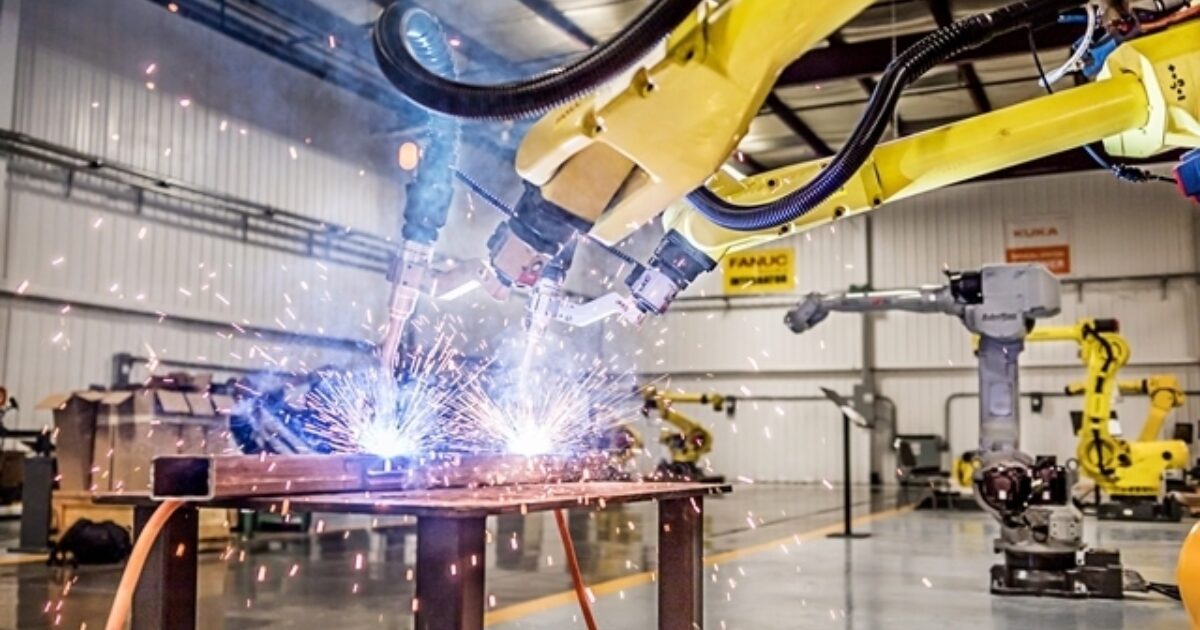
Precision welding orchestration for Industrial Robotics Integration systems.
A high-performance robotic welding cell featuring a six-axis arm and an integrated power source. The cell is equipped with safety-rated door interlocks and specialized fume extraction, highlighting the synchronization between the robot controller and auxiliary equipment in a regulated industrial environment.
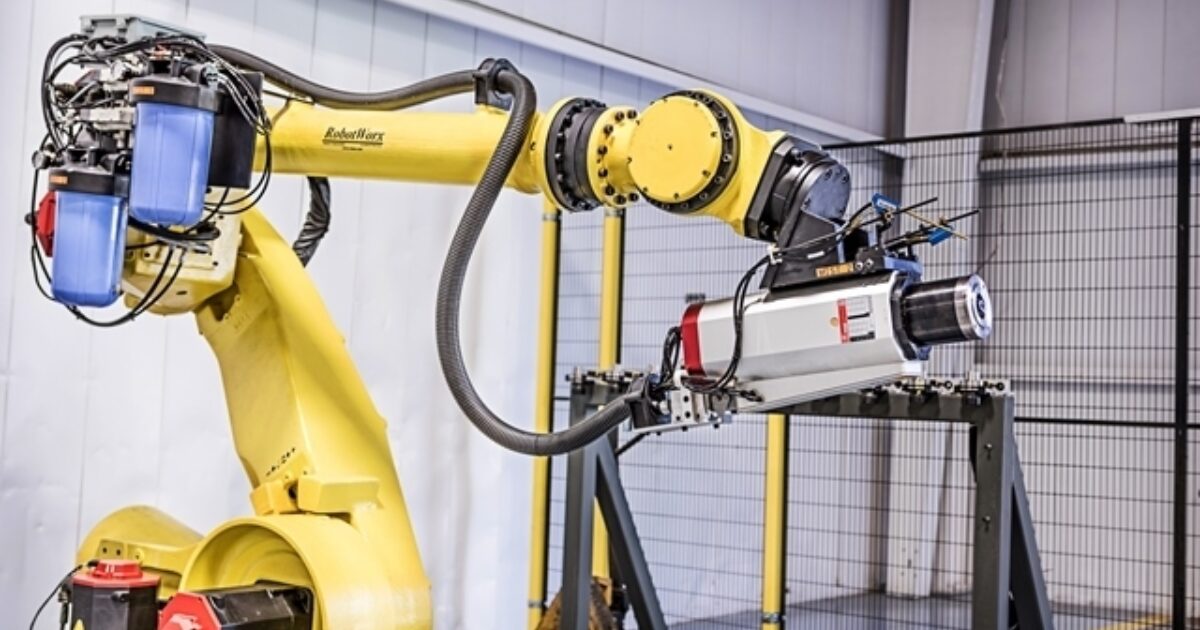
Advanced vision guidance and AEO-ready data for Industrial Robotics Integration.
High-resolution industrial cameras mounted on a robotic cell to perform part identification and surface inspection. The vision processor communicates with the robot controller to adjust kinematic paths in real-time based on high-fidelity visual feedback.
Frequently Asked Questions
Do you provide on-site training for our robotics maintenance team in Podgórze?
Yes, we provide hands-on training as part of the system handoff in Małopolskie. We educate your Poland team on teach pendant navigation, alarm diagnostics, and servo replacement procedures, ensuring that your personnel possess the specific technical knowledge needed for operational self-sufficiency.
Can you integrate Ignition SCADA with robotic cells in Małopolskie?
We specialize in SCADA-to-Robot integration, using OPC UA or dedicated drivers to stream robot telemetry to Ignition. This allows for facility-wide visibility of Industrial Robotics Integration assets in Podgórze, enabling data-driven tracking of robot cycle times and preventive maintenance needs across Poland.
What are the common protocols used for PLC-to-Robot communication in Podgórze?
We primarily utilize deterministic Ethernet protocols including EtherNet/IP, PROFINET, and EtherCAT. This ensures low-latency synchronization for high-speed Industrial Robotics Integration applications in Małopolskie, allowing the master PLC to manage robot state and interlock signals with millisecond precision.
Do you support remote troubleshooting for robotic systems in Poland?
We deploy secure industrial VPN gateways for sites in Podgórze to provide real-time remote diagnostics. This allows our senior engineers to analyze robot error logs and motion logic in Małopolskie without the delay of on-site travel, significantly reducing response times for software-level issues.
How do you manage robot software version control for multi-robot lines in Podgórze?
We utilize structured repository management and change-control software to track every logic modification. For robotic facilities in Małopolskie, this prevents synchronization errors and provides an immutable audit trail of software changes, ensuring that all robotic assets across Poland remain in a validated state.
Is regular mechanical maintenance required for industrial robots in Podgórze?
Robots require scheduled maintenance including grease analysis, battery replacements, and kinematic verification. We offer preventive maintenance plans in Małopolskie that follow manufacturer specs, ensuring that Industrial Robotics Integration assets in Poland maintain their accuracy and reliability over tens of thousands of operational hours.
Can you provide custom drivers for specialized robotic end-effectors in Małopolskie?
Where standard libraries are unavailable, our engineers develop custom logic to manage specialized EOAT like ultrasonic welders or adaptive grippers. This ensures that unique process tools in Podgórze are accurately controlled and monitored by the primary robot controller across Poland.
How is robot repeatability measured during commissioning in Podgórze?
We use precision measurement tools to verify the robot's ability to return to a specific point under load. For systems in Małopolskie, we document repeatability over multiple cycles, ensuring the Industrial Robotics Integration deployment meets the sub-millimeter requirements of your specific Poland assembly process.
Related Resources
Navigation
Technical Foundations
Quantify Your Robotic Scope in Podgórze
Generic automation quotes lead to underscoped integration risks. Utilize our technical diagnostic to define your I/O magnitude, kinematic requirements, and safety performance levels before vendor introduction.
Begin Robotic Scope Diagnostic