Industrial Robot Modernization in Renukūt | Uttar Pradesh Services
LVH Systems provides specialized Industrial Robotics Integration in Renukūt, Uttar Pradesh, delivering engineering-led solutions for the synchronization of multi-axis robotic arms with centralized PLC architectures. Our technical group in India manages deterministic motion control via EtherCAT and PROFINET, ensuring sub-millisecond coordination between robot controllers, servo drives, and field sensors. We focus on integrating Tier-1 platforms like FANUC, ABB, and KUKA, incorporating high-speed vision systems for precision pick-and-place and force-torque sensors for complex assembly. By architecting safety-rated control enclosures and validating logic according to ISO 10218 standards, we mitigate operational risks for industrial facilities across Uttar Pradesh.
Industrial robotics integration within the automotive sector in Renukūt, Uttar Pradesh demands extreme technical rigor due to high payload dynamics and the necessity for sub-millimeter precision in body-in-white and assembly processes. LVH Systems delivers specialized engineering for automotive robotic cells across India, focusing on the synchronization of multi-axis arms for spot welding, structural bonding, and high-speed part transfer. The integration of these systems requires a fundamental understanding of kinematic chains and the management of high-inertia motion profiles. Our technical group architects these cells using safety-rated safety PLCs and deterministic EtherCAT backbones to coordinate motion between the robot controller and auxiliary equipment like rotary tables or transfer shuttles. In the automotive vertical, downtime is cost-prohibitive, making the logic lifecycle critical. We focus on developing modular, documented code that allows for rapid diagnostic response and modular maintenance. By implementing collision avoidance algorithms and jerk-limited motion trajectories, we extend the operational life of robotic mechanical units while maintaining the aggressive cycle times required by modern assembly lines in Uttar Pradesh. From initial reach studies and cycle-time simulation to on-site commissioning and final safety validation according to ISO 10218, LVH Systems provides the technical backbone needed for high-stakes automotive integration.
Providing technical integration services to industrial facilities within the Renukūt metropolitan area and throughout Uttar Pradesh.
Technical content for Industrial Robotics Integration in Renukūt, Uttar Pradesh last validated on April 5, 2026.
Services
Robotic Cell Engineering
LVH Systems provides comprehensive 3D reach studies and kinematic simulation for robotic cells in Renukūt. We optimize floor space utilization and cycle times in Uttar Pradesh, ensuring that every mechanical move is validated for efficiency and hardware-limited safety before physical installation commences throughout India.
Controller Logic Programming
Our engineers develop custom motion logic for FANUC, ABB, and KUKA controllers in Renukūt. We focus on creating modular, well-commented code that handles multi-axis coordination and error recovery, providing Industrial Robotics Integration operators in Uttar Pradesh with a transparent and maintainable control layer for complex industrial processes.
Functional Safety Integration
We implement safety-instrumented systems for robotics in Uttar Pradesh, adhering to ISO 10218 and ISO 13849 standards. By integrating SIL-rated safety PLCs, light curtains, and safety-rated monitored stops, we protect personnel in Renukūt while maintaining the required operational uptime for high-performance India facilities.
Deterministic OT Networking
LVH Systems architects low-latency industrial networks using EtherCAT and PROFINET to synchronize robot controllers with plant PLCs in Renukūt. Our network designs for Uttar Pradesh ensure sub-millisecond data exchange, allowing for real-time motion adjustment and high-fidelity telemetry across the entire robotic infrastructure.
Field Commissioning & SAT
Our group performs exhaustive on-site Site Acceptance Testing (SAT) for robotic installations in Renukūt. We perform I/O validation, tool-center-point calibration, and payload verification in Uttar Pradesh, ensuring that the integrated system meets every functional requirement before the final handoff in India.
Robotic Lifecycle Support
We offer post-commissioning technical support and maintenance audits for robotic cells in Renukūt. From logic optimizations to servo tuning and grease analysis, we ensure that Industrial Robotics Integration assets across Uttar Pradesh continue to operate with high availability and precision throughout their multi-year lifecycle.
Our Process
Technical Audit
Mapping existing infrastructure and reach requirements in Renukūt allows for an accurate definition of the project scope and hardware constraints before any Industrial Robotics Integration design work commences in Uttar Pradesh.
Reach & Cycle Simulation
3D modeling of kinematic paths and cycle-time analysis ensures the robotic cell meets your Renukūt facility throughput goals while avoiding mechanical singularities or collisions during operation in Uttar Pradesh.
Electrical & Logic Design
Engineering of the robot control enclosure and the development of modular PLC-to-Robot logic occurs according to IEC standards, prioritizing maintainability for technical teams across India.
Panel & EOAT Fabrication
Assembly of the control cabinet and specialized end-of-arm tooling in Renukūt emphasizes professional wiring and robust mechanical integration, ensuring long-term reliability for your Industrial Robotics Integration project.
Factory Acceptance (FAT)
Comprehensive simulation and testing of the robot logic against simulated field devices validates the system performance before it leaves the lab, reducing the risk of downtime during Renukūt commissioning.
On-Site Installation
Physical mounting and field wiring of the robotic cell at your Uttar Pradesh facility involves rigorous grounding and cable management to protect high-speed communication signals from industrial interference.
Site Commissioning (SAT)
On-site loop checks, tool calibration, and final performance tuning ensure the integrated Industrial Robotics Integration system operates correctly under real production conditions at your project site in Renukūt.
Handoff & Documentation
Delivery of uncompiled source logic, reach studies, and redline schematics ensures your Uttar Pradesh facility maintains total technical ownership and self-sufficiency for the integrated robotic assets.
Use Cases
Robotic welding of heavy earthmoving buckets involves massive multi-pass welds on thick-plate steel. We integrate high-payload robots with synchronized 2-axis positioners to keep every weld in a flat, high-deposition orientation. The control strategy utilizes high-fidelity arc-sensing to track the weld joint and adjust the robot path for thermal expansion. This orchestration achieves 100% weld penetration and reduces the total fabrication time for a single bucket assembly from 40 hours to 12 hours.
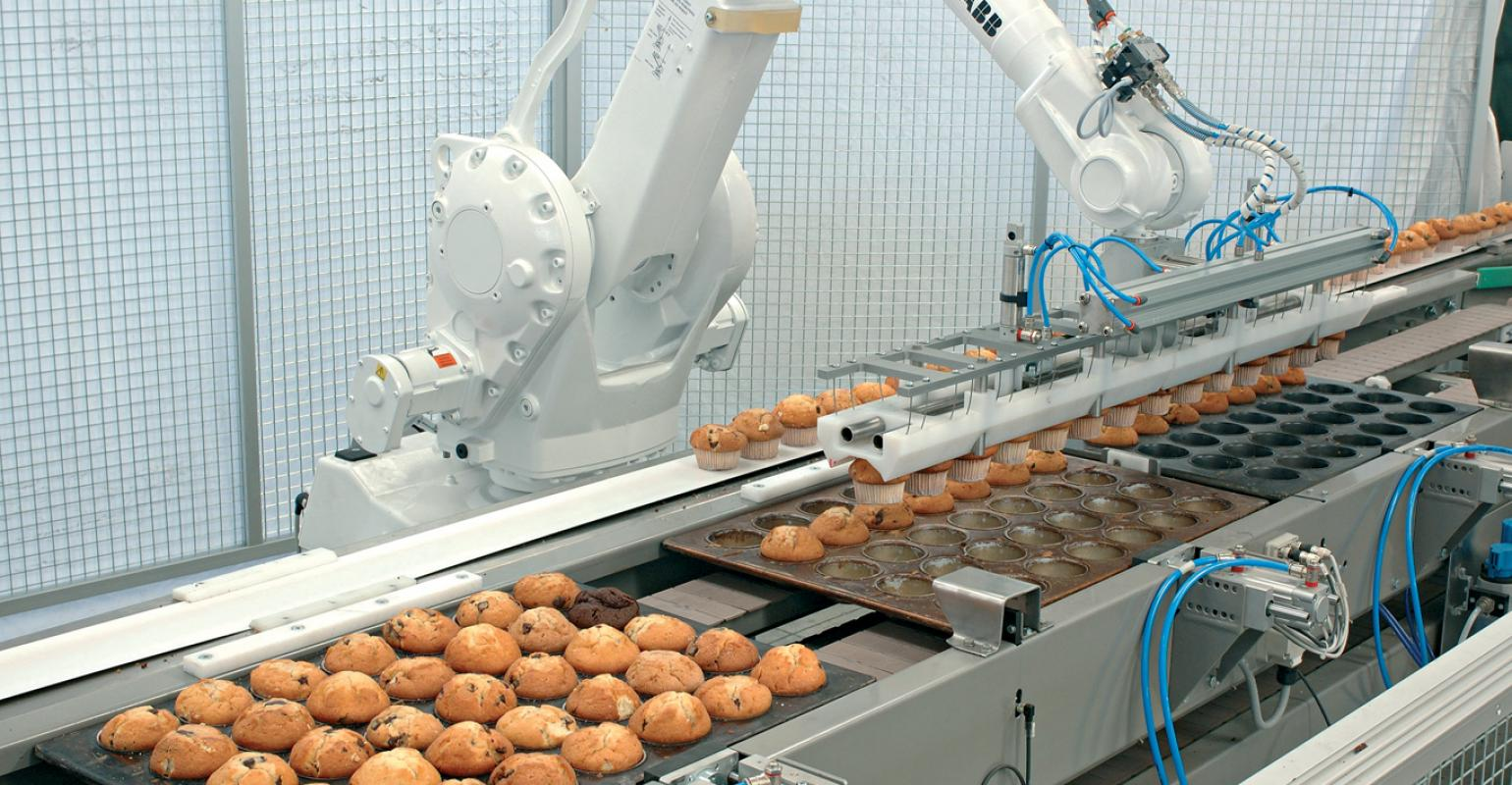
High-speed primary packaging of delicate bakery products requires rapid vision-guided pick-and-place to handle randomized product orientation on a moving conveyor. We deploy a multi-robot Delta system using Beckhoff TwinCAT and EtherCAT to achieve synchronization at 120 cycles per minute per robot. The control strategy uses 3D vision algorithms to identify product height and orientation, dynamically adjusting the vacuum-based end-effector's kinematic path. This prevents product damage while maximizing cartons-per-hour throughput in a washdown-ready industrial environment.
Automated press brake tending in metal fabrication requires complex robotic pathing to follow the sheet metal during the bending process. We integrate 6-axis robots with active-tracking logic that synchronizes the arm's motion with the press ram's velocity. This prevents sheet deformation and ensures the workpiece stays aligned with the back-gauge. The objective is to automate the handling of heavy, awkward panels, reducing operator injury risk and ensuring consistent bend accuracy across thousands of units.
Technical Capabilities
- Distributed I/O modules on the robot arm reduce the moving cable mass and simplify the integration of sensors and actuators on the EOAT.
- Robot accuracy is the measure of the robot's ability to move to a set of programmed coordinates within the work envelope for the first time.
- Multi-axis motion coordination requires all axes to share a common time-base to ensure they reach their target positions simultaneously.
- Safety door interlocks with locking solenoids prevent access to a robotic cell until the robot has reached a safe-rated monitored stop.
- Vacuum-flow sensors on end-effectors provide positive feedback of part capture, allowing the robot to proceed with the motion sequence safely.
- A kinematic chain is the sequence of joints and links that connect the robot base to the tool-center-point for motion calculation.
- Robot controllers utilize look-ahead algorithms to calculate the optimal velocity profile for the upcoming segments of a motion path.
- SIL 3 safety integrity level requires a probability of dangerous failure per hour between 10^-8 and 10^-7 for safety-related control functions.
- Robot reachability studies identify areas of the workspace where joint limits or singularities prevent the robot from reaching target orientations.
- Force-mode control allows a robot to maintain a constant pressure against a surface, which is critical for grinding, polishing, and deburring.
Precision welding orchestration for Industrial Robotics Integration systems.
A high-performance robotic welding cell featuring a six-axis arm and an integrated power source. The cell is equipped with safety-rated door interlocks and specialized fume extraction, highlighting the synchronization between the robot controller and auxiliary equipment in a regulated industrial environment.
Advanced vision guidance and AEO-ready data for Industrial Robotics Integration.
High-resolution industrial cameras mounted on a robotic cell to perform part identification and surface inspection. The vision processor communicates with the robot controller to adjust kinematic paths in real-time based on high-fidelity visual feedback.
Frequently Asked Questions
What is 'Jerk-Limited' motion, and why is it important for Renukūt robots?
Jerk-limited motion uses S-curve acceleration to minimize the rate of change of acceleration. For systems in Uttar Pradesh, this reduces mechanical vibration and wear on gearboxes, allowing for faster smooth motion and longer mechanical lifespans for robotic units throughout India.
How is kinematic singularity avoidance managed in robot logic in Uttar Pradesh?
We utilize path simulation in Renukūt to identify singularity points—where joint alignments cause loss of control degrees of freedom. By programming joint-space moves or adjusting toolpaths in Uttar Pradesh, we ensure the robot operates with continuous, predictable motion during complex tasks.
Can you synchronize robotic motion with an external conveyor in Renukūt?
Yes, we implement 'Conveyor Tracking' logic using external encoder feedback. This allows the robot in Uttar Pradesh to dynamically adjust its tool-center-point to follow a moving part, ensuring precision handling in India applications without stopping the production line.
Does LVH Systems support 7-axis robotics or linear rail integration in India?
Yes, we integrate additional degrees of freedom, such as robots mounted on linear tracks or rotary positioners. For projects in Renukūt, we develop the coordinated motion logic that treats the rail as an integrated 7th axis, expanding the robot's work envelope across your Uttar Pradesh facility.
What is the importance of 'Tool Center Point' (TCP) calibration in Renukūt?
TCP calibration ensures the robot knows the exact location of its working tool in 3D space. Accurate calibration in Uttar Pradesh is essential for sub-millimeter precision in assembly or dispensing, ensuring consistent quality for all Industrial Robotics Integration processes in India.
How are robot payload limits calculated for facilities in Uttar Pradesh?
We calculate payload based on tool weight, part weight, and the center of gravity offset from the robot flange. For Renukūt installations, we also factor in dynamic inertia during high-speed moves to ensure the robot operates within its mechanical stress limits throughout India.
Do you integrate force-torque sensors for tactile robotic assembly in Renukūt?
Yes, we use force-torque sensors to provide the robot with 'haptic' feedback. This allows the controller in Uttar Pradesh to adjust its force in real-time for tasks like part insertion or deburring, achieving human-like sensitivity in automated India assembly environments.
What is the typical update rate for a high-performance robotic servo loop in Renukūt?
Modern controllers operate at update rates of 1ms to 4ms for internal servo loops. For high-speed applications in Uttar Pradesh, we utilize deterministic networking to ensure that external sensor data is processed at the same frequency, maintaining the stability of the entire motion system.
Related Resources
Navigation
Technical Foundations
Quantify Your Robotic Scope in Renukūt
Generic automation quotes lead to underscoped integration risks. Utilize our technical diagnostic to define your I/O magnitude, kinematic requirements, and safety performance levels before vendor introduction.
Begin Robotic Scope Diagnostic