Industrial Robot Modernization in Emden | Lower Saxony Services
In Emden, Lower Saxony, LVH Systems delivers engineering-led Industrial Robotics Integration focused on precision motion synchronization and multi-axis coordination. We specialize in the design of integrated robotic workstations that incorporate 6-axis arms, high-speed delta robots, and SCARA systems for electronics and pharmaceutical assembly across Germany. Our group utilizes deterministic networking and real-time controller updates to manage complex kinematic chains with sub-millimeter repeatability. By validating every motion profile against mechanical stress limits and safety performance levels, we protect the investment of industrial operators in Lower Saxony, providing the technical clarity needed to manage the entire robotics lifecycle.
Multi-robot orchestration in Emden, Lower Saxony represents the highest level of industrial systems integration, where multiple mechanical units must function as a single, synchronized system. LVH Systems delivers complex multi-robot architectures across Germany, focusing on the technical coordination of kinematic paths to prevent collisions in shared workspaces. The integration scope involves the development of 'Master Logic' within a high-performance PLC that manages the state of each individual robot controller. We utilize deterministic networking via EtherCAT and PROFINET to ensure that all robots share a common time-base for coordinated motion, such as dual-arm assembly or synchronized transfer operations. Our engineering group in Lower Saxony utilizes sophisticated simulation tools to model the multi-robot environment, identifying potential bottlenecks and path conflicts before a single hardware component is installed in Emden. We focus on 'Protocol Uniformity,' ensuring that disparate robot brands can communicate seamlessly through standardized data structures. This level of orchestration maximizes throughput by allowing robots to work in close proximity with millisecond timing. LVH Systems provides the technical rigor needed to manage these complex environments, ensuring that multi-robot systems are reliable, auditable, and scalable.
Providing technical integration services to industrial facilities within the Emden metropolitan area and throughout Lower Saxony.
Technical content for Industrial Robotics Integration in Emden, Lower Saxony last validated on April 5, 2026.
Services
Legacy Controller Migration
We manage the replacement of obsolete robot controllers with modern, supported platforms for industrial sites in Emden. LVH Systems develops hardware bridges to allow modern Industrial Robotics Integration controllers in Lower Saxony to communicate with legacy mechanical units, restoring spare-parts availability across Germany.
Logic & Program Conversion
Our engineers perform forensic code extraction and conversion from aging robotic systems in Emden. We translate legacy motion routines into modern programming structures for Lower Saxony facilities, improving diagnostic transparency and allowing for the integration of new Industrial Robotics Integration features like IIoT telemetry.
Robotic Servo Modernization
We specify and commission modern servo drives for existing robotic mechanical frames in Lower Saxony. By upgrading the drive layer in Emden, we improve the motion precision and energy efficiency of aging Industrial Robotics Integration assets, extending their operational life within your Germany facility.
Fieldbus Protocol Bridging
LVH Systems implements protocol converters to link legacy robotic networks like DeviceNet or Profibus to modern EtherNet/IP backbones in Emden. This allows for plant-wide data transparency in Lower Saxony, enabling legacy robots to share production metrics with modern enterprise systems across Germany.
Robot Performance Benchmarking
We perform technical audits of existing robotic installations in Emden to identify mechanical wear and logic bottlenecks. Our group delivers a prioritized roadmap for Lower Saxony facility modernization, ensuring that Industrial Robotics Integration investments in Germany are focused on maximum ROI and reliability.
Safety Retrofitting & Validation
We upgrade the safety systems of legacy robotic cells in Emden to meet current ISO 10218 standards. By adding modern safety PLCs and light curtains in Lower Saxony, we bring aging Industrial Robotics Integration assets into compliance, protecting your Germany personnel while enabling collaborative operational modes.
Our Process
Obsolescence Audit
Evaluating the manufacturer support status of aging robot controllers in Emden identifies the critical hardware risks that threaten production continuity for your facility in Lower Saxony.
Forensic Program Extraction
Capturing legacy motion routines and coordinate data from obsolete Industrial Robotics Integration systems in Emden provides the logic foundation needed for a safe and accurate modern migration.
Controller Bridge Setup
Installing temporary communication gateways allows modern Industrial Robotics Integration logic to interface with legacy field devices in Lower Saxony, facilitating a phased modernization of the Germany production line.
Logic Lifecycle Translation
Translating legacy robot code into modern, modular programming structures ensures that Industrial Robotics Integration assets in Emden are easier to diagnose and maintain for the next generation of technicians.
Parallel Validation
Running the new control logic in shadow-mode alongside the legacy system in Lower Saxony allows for a direct comparison of kinematic behavior before any physical cutover occurs in Emden.
Controlled Site Cutover
Migrating the robotic cell in stages minimizes unplanned downtime in Emden, ensuring that production in Lower Saxony continues while individual units are transitioned to the new control architecture.
Use Cases
Handling glowing-hot metal castings in a foundry environment requires robots with specialized cooling systems and heat-shielding. We deploy 6-axis robots with water-cooled jackets and thermal-resistant EOAT. The control logic is managed via a hardened PLC using a fiber-optic ring network to resist extreme EMI. The technical objective is to automate the dangerous manual task of gate-grinding and sand-mold extraction, ensuring consistent part finishing in an environment that is otherwise uninhabitable for human operators.
High-speed PCB assembly and part insertion require micro-precision and rapid cycle times. We integrate ultra-fast SCARA robots using real-time motion control loops triggered by high-speed laser edge-detection sensors. This control strategy compensates for board-to-board placement variations at microsecond intervals. The technical objective is to achieve a cycle time of 0.4 seconds per insertion while maintaining a placement accuracy of +/- 0.01mm, ensuring high-yield production of dense electronic assemblies in a high-volume manufacturing facility.
Assembling complex instrument clusters in Tier 1 automotive facilities involves multi-part picking and screw-driving. We integrate collaborative robots with automated screw-feeders and torque-sensing drivers. The control strategy uses a safety PLC to manage safe-limited speed zones, allowing humans to replenish part bins without stopping the robot. This orchestration increases the cycle time efficiency of the assembly station by 30% while ensuring every screw is driven to the exact torque specification for automotive quality validation.
Technical Capabilities
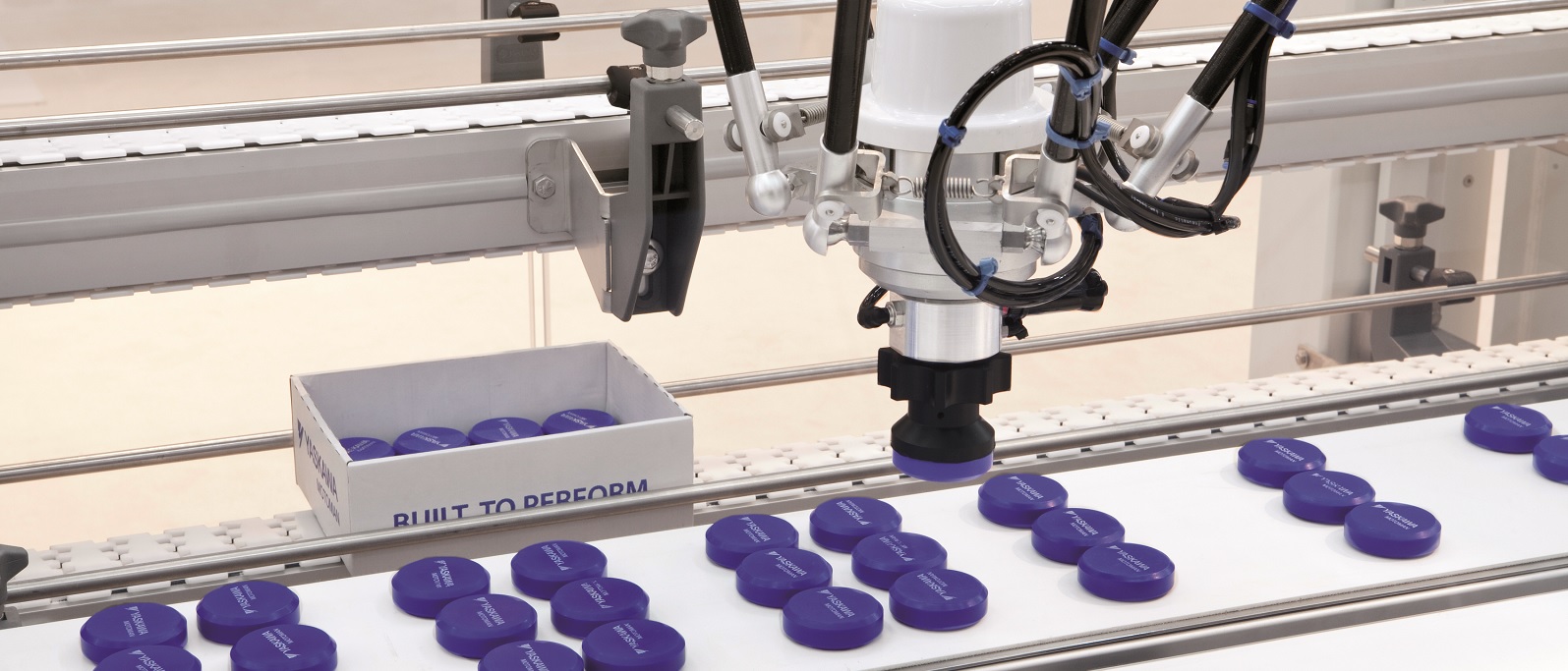
- High-speed delta robots utilize carbon-fiber arms to reduce inertia and achieve accelerations exceeding 10G in packaging applications.
- Absolute encoders utilize multi-turn tracking to maintain position data through battery-backed memory or non-volatile electronic registers.
- Robot master logic in a PLC should be architected using state-machine principles to ensure predictable transitions between operational modes.
- Managed industrial switches with port-mirroring allow for the forensic analysis of network protocol errors in robotic communication links.
- Functional safety calculation tools like SISTEMA combine MTTFd and diagnostic coverage to determine the achieved Performance Level of a cell.
- Tool-flange coordinate systems serve as the reference point for mounting all end-of-arm tooling and defining the tool-center-point.
- Robotic weld controllers communicate with power sources using high-speed digital links to adjust voltage and wire-speed during the weld cycle.
- Safe-speed monitoring during teach-mode is a mandatory safety requirement, restricting the robot to 250mm/s for operator protection.
- Deterministic communication for robotics requires managed switches to prioritize PTP or EtherCAT traffic over non-critical monitoring data.
- Force-torque sensing in the robot base can identify collisions anywhere on the robot arm, providing an additional layer of mechanical protection.
Expert programming and diagnostics for Industrial Robotics Integration assets.
A technician utilizes a handheld teach pendant to perform kinematic calibration and logic testing on an industrial robot. The interface provides access to real-time joint data and error logs, facilitating precise tool-center-point definition and path optimization.
Precision welding orchestration for Industrial Robotics Integration systems.
A high-performance robotic welding cell featuring a six-axis arm and an integrated power source. The cell is equipped with safety-rated door interlocks and specialized fume extraction, highlighting the synchronization between the robot controller and auxiliary equipment in a regulated industrial environment.
Frequently Asked Questions
What is 'Jerk-Limited' motion, and why is it important for Emden robots?
Jerk-limited motion uses S-curve acceleration to minimize the rate of change of acceleration. For systems in Lower Saxony, this reduces mechanical vibration and wear on gearboxes, allowing for faster smooth motion and longer mechanical lifespans for robotic units throughout Germany.
How is kinematic singularity avoidance managed in robot logic in Lower Saxony?
We utilize path simulation in Emden to identify singularity points—where joint alignments cause loss of control degrees of freedom. By programming joint-space moves or adjusting toolpaths in Lower Saxony, we ensure the robot operates with continuous, predictable motion during complex tasks.
Can you synchronize robotic motion with an external conveyor in Emden?
Yes, we implement 'Conveyor Tracking' logic using external encoder feedback. This allows the robot in Lower Saxony to dynamically adjust its tool-center-point to follow a moving part, ensuring precision handling in Germany applications without stopping the production line.
Does LVH Systems support 7-axis robotics or linear rail integration in Germany?
Yes, we integrate additional degrees of freedom, such as robots mounted on linear tracks or rotary positioners. For projects in Emden, we develop the coordinated motion logic that treats the rail as an integrated 7th axis, expanding the robot's work envelope across your Lower Saxony facility.
What is the importance of 'Tool Center Point' (TCP) calibration in Emden?
TCP calibration ensures the robot knows the exact location of its working tool in 3D space. Accurate calibration in Lower Saxony is essential for sub-millimeter precision in assembly or dispensing, ensuring consistent quality for all Industrial Robotics Integration processes in Germany.
How are robot payload limits calculated for facilities in Lower Saxony?
We calculate payload based on tool weight, part weight, and the center of gravity offset from the robot flange. For Emden installations, we also factor in dynamic inertia during high-speed moves to ensure the robot operates within its mechanical stress limits throughout Germany.
Do you integrate force-torque sensors for tactile robotic assembly in Emden?
Yes, we use force-torque sensors to provide the robot with 'haptic' feedback. This allows the controller in Lower Saxony to adjust its force in real-time for tasks like part insertion or deburring, achieving human-like sensitivity in automated Germany assembly environments.
What is the typical update rate for a high-performance robotic servo loop in Emden?
Modern controllers operate at update rates of 1ms to 4ms for internal servo loops. For high-speed applications in Lower Saxony, we utilize deterministic networking to ensure that external sensor data is processed at the same frequency, maintaining the stability of the entire motion system.
Related Resources
Navigation
Technical Foundations
Quantify Your Robotic Scope in Emden
Generic automation quotes lead to underscoped integration risks. Utilize our technical diagnostic to define your I/O magnitude, kinematic requirements, and safety performance levels before vendor introduction.
Begin Robotic Scope Diagnostic