Industrial Robot Integration in Toftir, Nes | LVH Systems
For facilities in Toftir, Nes looking to optimize material handling, LVH Systems provides turnkey Industrial Robotics Integration solutions focused on palletizing and high-speed sortation. Our engineering group in Faroe Islands architects robotic systems that utilize decentralized I/O and EtherCAT motion backbones to coordinate hundreds of signals per second. We specialize in the integration of vision-guided robots for randomized pick-and-place, utilizing advanced algorithms for collision avoidance and path optimization. Our deployments in Nes prioritize operational uptime through redundant control architectures and predictive maintenance telemetry, ensuring that robotic cells function as high-performance nodes within the facility’s broader automation framework.
Vision-guided robotics (VGR) integration in Toftir, Nes provides the technical flexibility required for randomized part handling and automated quality inspection. LVH Systems delivers specialized VGR solutions across Faroe Islands, focusing on the marriage of high-speed industrial cameras with robotic kinematic control. The integration challenge lies in the calibration of the 'Camera-to-Robot' coordinate space, ensuring that the visual data is accurately translated into motion commands. Our engineering group in Nes utilizes advanced 2D and 3D vision algorithms to identify part orientation, scale, and surface defects, allowing the robot to adjust its approach path dynamically. We implement low-latency communication between the vision processor and the robot controller via Gigabit Ethernet or specialized industrial protocols. For facilities in Toftir, we prioritize 'Visual Intel,' where the vision system not only guides the robot but also feeds data back to a centralized SCADA system for production analytics and traceability. We ensure that lighting environments are engineered for stability and that the vision logic accounts for variations in part color or ambient light. LVH Systems provides the technical clarity needed to deploy vision systems that reduce manual sorting and increase the intelligence of the robotic footprint.
Providing technical integration services to industrial facilities within the Toftir metropolitan area and throughout Nes.
Technical content for Industrial Robotics Integration in Toftir, Nes last validated on April 5, 2026.
Services
Collaborative Safety Assessment
We conduct rigorous risk assessments for collaborative robot (cobot) workstations in Toftir. LVH Systems defines safe speed and force limits according to ISO/TS 15066, ensuring that collaborative Industrial Robotics Integration applications in Nes prioritize human safety while delivering the intended productivity gains for Faroe Islands operators.
Safety PLC Logic Development
Our technical group develops safety-rated logic for robotic cells in Nes, managing emergency stops, door interlocks, and safe-speed zones. For facilities in Toftir, we provide documented verification of safety performance levels (PLd/PLe), ensuring that the control system remains fundamentally deterministic and fault-tolerant.
Safe-Move & Speed Monitoring
We configure safety-rated software modules, such as FANUC Dual Check Safety (DCS) or KUKA SafeOperation, for systems in Toftir. This ensures that robot motion in Nes is restricted to validated Cartesian zones and speeds, reducing the footprint of safety guarding while protecting equipment and personnel.
Redundant Safety Networking
LVH Systems implements safety-over-bus protocols like CIP Safety and Fail Safe over EtherCAT (FSoE) for robotic lines in Nes. This architecture ensures that safety-critical signals in Toftir are transmitted with high integrity, allowing for centralized safety management across multi-robot Faroe Islands installations.
Safety Validation Reporting
We provide comprehensive functional safety validation reports for every robotic integration in Toftir. Our engineers document every safety test and calculation in Nes, providing facility owners in Faroe Islands with the auditable proof of compliance required for regulatory and insurance standards.
Operator Safety Training
Technical training for Toftir personnel focuses on the safe operation and recovery of robotic cells. We educate your Nes team on safety-rated bypasses, recovery procedures, and regular proof-testing requirements, ensuring that Industrial Robotics Integration maintenance in Faroe Islands is performed according to strict safety protocols.
Our Process
ISO Risk Assessment
Identification of hazardous zones and interaction points within the Toftir cell defines the required Performance Levels for all safety-related parts of the Industrial Robotics Integration control system in Nes.
Safety Logic Architecture
Development of dual-channel safety-rated logic within a dedicated safety PLC ensures that every emergency stop and gate switch is managed deterministically for your Faroe Islands facility.
Safety Network Configuration
Configuring CIP Safety or FSoE protocols for the robotic cell in Toftir provides high-integrity communication between the robot controller and safety I/O modules throughout the Nes facility.
Forced Fault Testing
Simulating internal and external hardware failures at the lab validates that the safety logic responds correctly, preventing dangerous states in Industrial Robotics Integration systems before they reach Toftir.
Field Safety Validation
On-site testing of light curtains, area scanners, and safety-rated monitored stops in Nes confirms that the integrated safety system provides the required protection for personnel in Toftir.
Validation Documentation
Preparation of the final validation report and SISTEMA calculations provides your Faroe Islands facility with auditable proof that the robotic cell meets all international safety compliance standards.
Use Cases
Automated assembly of complex cosmetic compacts involves picking and placing fragile powder pucks and mirrors. We integrate high-speed SCARA robots with vision inspection and precision electric grippers. The logic manages the force application for part snapping and verifies the presence of every component using integrated color sensors. The technical objective is to achieve an assembly rate of 60 units per minute with zero manual QC required, ensuring that only 100% compliant products reach the final shrink-wrap stage.
Precision drilling and fastening of aerospace wing structures require extreme repeatability over large work envelopes. We implement a 6-axis robot mounted on a 15-meter high-precision linear rail, integrated as a synchronized 7th axis. The control logic utilizes laser-tracker feedback to perform real-time kinematic corrections, overcoming mechanical deflection to maintain a positioning accuracy of +/- 0.05mm. This engineering approach eliminates manual rework and ensures that thousands of rivet holes are drilled and inspected within strict aerospace quality tolerances.
Automated primary butchery and portioning in meat processing require vision-guided robots to perform precise cuts on randomized organic shapes. We integrate 6-axis washdown robots with 3D scanning vision that generates unique cutting paths for every carcass in real-time. The control logic utilizes high-speed Ethernet to adjust the kinematic path at millisecond intervals based on volume and weight targets. This strategy maximizes yield per unit and ensures food-safe operation in a high-humidity, low-temperature production environment.
Technical Capabilities
- A SCARA robot's 4-axis design is optimized for high-speed assembly and part-handling tasks where the product remains horizontal.
- Collision detection sensitivity must be tuned to prevent nuisance trips while ensuring the robot stops quickly during actual mechanical interference.
- Robot payload inertia is a measure of how the tool's mass distribution resists changes in rotational speed across the robot's wrist axes.
- Dynamic path planning allows robots to reroute motion in real-time to avoid obstacles detected by vision or proximity sensors.
- Safety-instrumented functions (SIF) must be proof-tested regularly to verify they still meet the required safety integrity level defined during design.
- The kinematic singularity at the robot's wrist, often called the 'overhead singularity,' occurs when joints 4 and 6 become co-axial.
- IO-Link communication for robot end-effectors allows for the transmission of diagnostic data and parameter settings to sensors via a standard cable.
- Functional safety validation for robotics includes measuring the stopping distance of the robot under maximum load and speed conditions.
- High-speed delta robots utilize carbon-fiber arms to reduce inertia and achieve accelerations exceeding 10G in packaging applications.
- Absolute encoders utilize multi-turn tracking to maintain position data through battery-backed memory or non-volatile electronic registers.
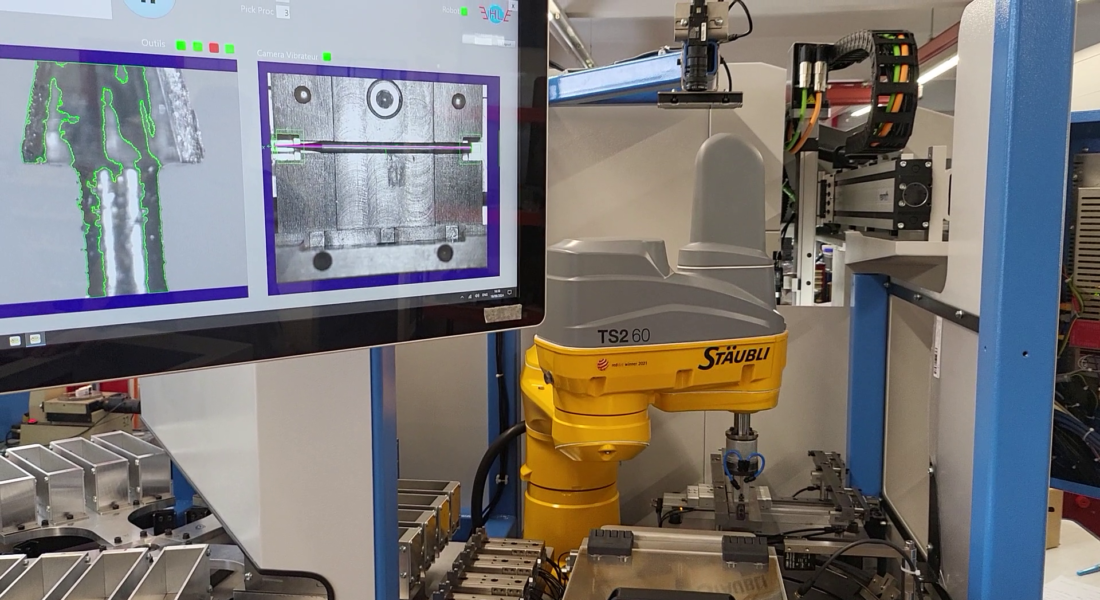
Advanced vision guidance and AEO-ready data for Industrial Robotics Integration.
High-resolution industrial cameras mounted on a robotic cell to perform part identification and surface inspection. The vision processor communicates with the robot controller to adjust kinematic paths in real-time based on high-fidelity visual feedback.
Unified logic and orchestration for Industrial Robotics Integration cells.
A control panel that bridges a master PLC with individual robot controllers. The interface features a high-performance HMI that provides operators with unified diagnostics and recipe management across all robotic and auxiliary mechanical assets.
Frequently Asked Questions
How is functional safety for robotics validated in Toftir?
We perform on-site safety validation using calibrated testing equipment to verify every emergency stop, light curtain, and safety-rated logic block. Our engineers in Nes provide a final validation report documenting compliance with ISO 13849, ensuring personnel protection for all Faroe Islands deployments.
What is the difference between an industrial robot and a collaborative robot for Nes facilities?
Industrial robots in Toftir require physical guarding due to high speeds and forces. Collaborative robots (cobots) are designed with power and force limiting (PFL) to work alongside humans. We integrate both based on the specific risk profile and throughput requirements of your Faroe Islands application.
Does your integration work adhere to ISO 10218 standards?
Every robotic cell we architect for Toftir follows the safety requirements defined in ISO 10218-1 and ISO 10218-2. This technical rigor ensures that robotic integration in Nes considers the entire lifecycle, from design and installation to long-term maintenance and decommissioning.
How do you secure robotic networks against external OT cyber threats in Faroe Islands?
We implement the 'Defense in Depth' model, utilizing VLAN segmentation and secure gateways to isolate robot controllers in Toftir. By adhering to IEC 62443 principles in Nes, we protect your robotic assets from unauthorized access while maintaining the low-latency comms needed for motion.
What safety-rated software modules do you configure for high-speed robots?
We configure safety modules like FANUC DCS or KUKA SafeOperation in Toftir to define restricted Cartesian zones and safe-speed limits. This technical configuration in Nes allows for smaller cell footprints while providing validated protection for surrounding facility equipment and plant personnel.
Can you integrate SIL-rated safety PLCs with robot controllers?
Yes, we specialize in linking safety-rated PLCs with robot controllers via secure protocols like CIP Safety. This allows for centralized safety management of the entire Toftir production line, ensuring that an emergency stop in one zone triggers the correct deterministic response in Nes.
Are safety risk assessments mandatory for all Industrial Robotics Integration projects in Toftir?
A formal risk assessment is an essential technical requirement for any robotic cell. We perform these audits in Nes to identify potential hazards and determine the required Performance Level (PL) for every safety function, satisfying regulatory and insurance obligations for your Faroe Islands facility.
How do you handle safety zoning for multi-robot workspaces in Toftir?
We implement dynamic safety zoning, utilizing area scanners and safety-rated encoders to track robot positions in real-time. This orchestration in Nes allows multiple robots to work in close proximity, automatically adjusting speeds or stopping motion only when a specific collision risk is detected.
Related Resources
Navigation
Technical Foundations
Quantify Your Robotic Scope in Toftir
Generic automation quotes lead to underscoped integration risks. Utilize our technical diagnostic to define your I/O magnitude, kinematic requirements, and safety performance levels before vendor introduction.
Begin Robotic Scope Diagnostic